

What’s on the notes page
How your notes get written
For each call, Metaview uses speech-to-text transcription to capture what was said. The full transcript is available to review alongside the recording. Based on the template you select, and any additional context or actions you add, Metaview uses the transcript and other available call context to generate your notes. Besides the transcript, some context may be added automatically, such as messages sent in the meeting chat and context from screen sharing, such as coding, demos, or presentations. You can also add more sources yourself, such as previous conversations or uploaded files.Selecting a template
Your notes are organized by the selected template, which you can change at any time by clickingUse template. Each template has a different purpose, and not every template suits every kind of call.
The template shapes the notes rather than the call, so it doesn’t matter what order things came up in — and you do not need to choose a template ahead of time. You can try several on the same conversation and keep whichever writes it up best.

Editing your notes
Metaview AI-generated notes are fully editable and allow you to edit, delete, correct, supplement, and personalize the final output based on your observations, priorities, and judgment. Edit the notes directly in the notes editor in your browser window, and they will be saved automatically. Metaview may sometimes mistranscribe certain words, especially proper nouns. If you correct the spelling of these words in your notes Metaview will prompt you to also update all other similar words found in the transcript and notes. ClickChange all to fix all occurrences, or Dismiss to not apply any additional corrections.
Formatting your notes
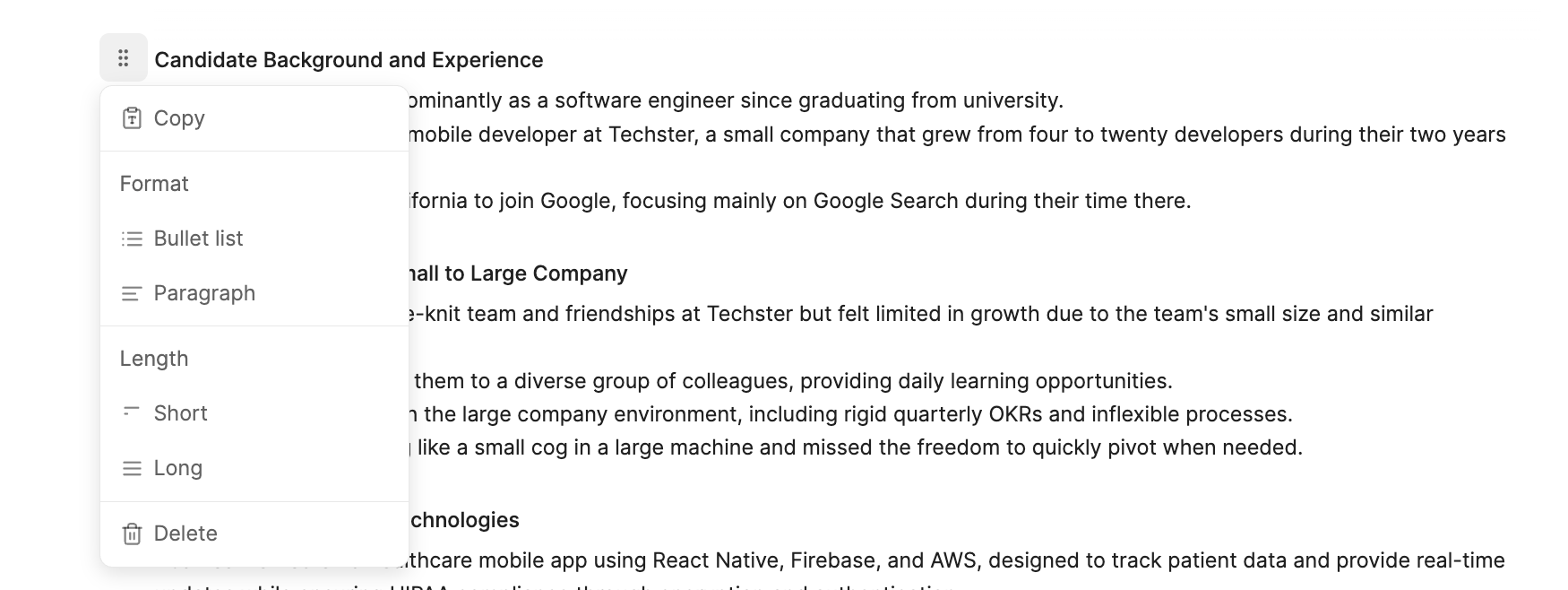
In the notes editor, you can format your notes with the following preset options:- Length:
+ longer,- shorter - Format:
Bullet points,Paragraphs - Pronouns:
they/them,she/her,he/him,tc/tc's(abbreviation for “the candidate”) - Identifier:
Refer to as "Candidate",Refer to as [Candidate name] - Select from bold, italic, underline, and
strikethroughbyhighlightingspecific words.
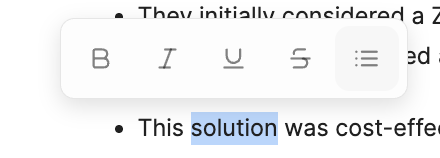
Metaview does not conduct any analysis to collect or try to infer the candidate’s pronouns. The “They” pronoun is applied by default to all candidates and can be adjusted if needed by the user.
Note sections
Each section in the notes can be reordered (drag the section by⋮⋮ icon in the top-left corner). You can also copy, reformat, or delete each section individually by clicking on the ⋮⋮ icon.
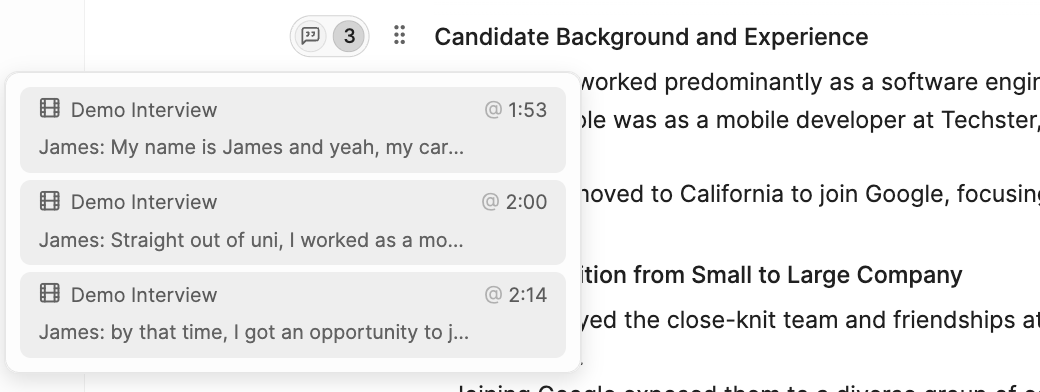
💬 (speech balloon) for the relevant section. Click on the segment, and you will jump directly to the part of the transcription where the information was taken from. If the information is found in more than one location, you will see a number of instances and the ability to jump to each one.
Adding sources
In addition to the recorded conversation, you can supplement your notes as well as your scorecard with additional previously captured conversations or additional context. Click on+ New source and either select past conversations on your Metaview account or upload a file. If you add additional sources, Metaview will generate notes for you based on the conversation and the additional sources you have added.
Elyse introduces our new Multi-source feature!
Pro tip: This is especially useful if a conversation took place in multiple parts — whether intentionally (like a follow-up call) or unintentionally (e.g., if the original call was cut off). You can combine both recordings to generate a single, coherent set of notes.
+ on a suggested source to include it.
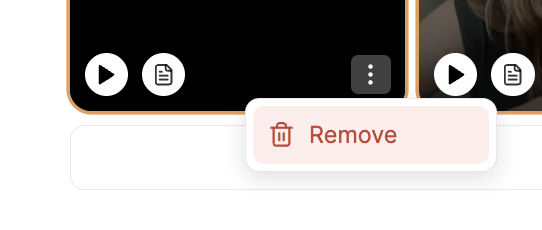
If you change your mind, you can easily remove additional sources. Click on the ⋮ (3 dots) to open the menu and select Remove.
Version history
Metaview automatically saves snapshots of your notes, so you can review previous versions, compare changes (including manual edits, formatting, or template changes), and revert if needed. ClickVersion at the bottom of the notes editor, select a previous version, turn on Compare to see what changed, and click Use this version to restore that version.

Actions you can take
The Actions panel on the right of the notes page is where the conversation connects to the rest of your workflow.Share and export
Copy or download notes, push them to your ATS, fill a scorecard, send to Zapier, or share the conversation with colleagues and people outside your workspace.
Add to collection
Group the call with everything else for that role, client, or project — and share the whole group in one go.
Find similar candidates
Use the person you just interviewed as the brief for a new sourcing search.
Open in your ATS
Jump to the matched candidate record, or open their public professional profile.
View scorecard
Open the scorecard your call was matched to and fill it from your notes.
Delete or redact
Remove a conversation entirely, or redact selected content from everything derived from it.
Feedback on Notes
We strive to provide the highest quality and most accurate notes for talent conversations, but we can’t do it without your help! Your feedback is greatly appreciated and is closely monitored by our product team and tracked by our leadership. If you’d like to share your thoughts on the quality, accuracy, usability, or overall usefulness of your notes, please use the feedback submission feature located at the bottom of your notes.