

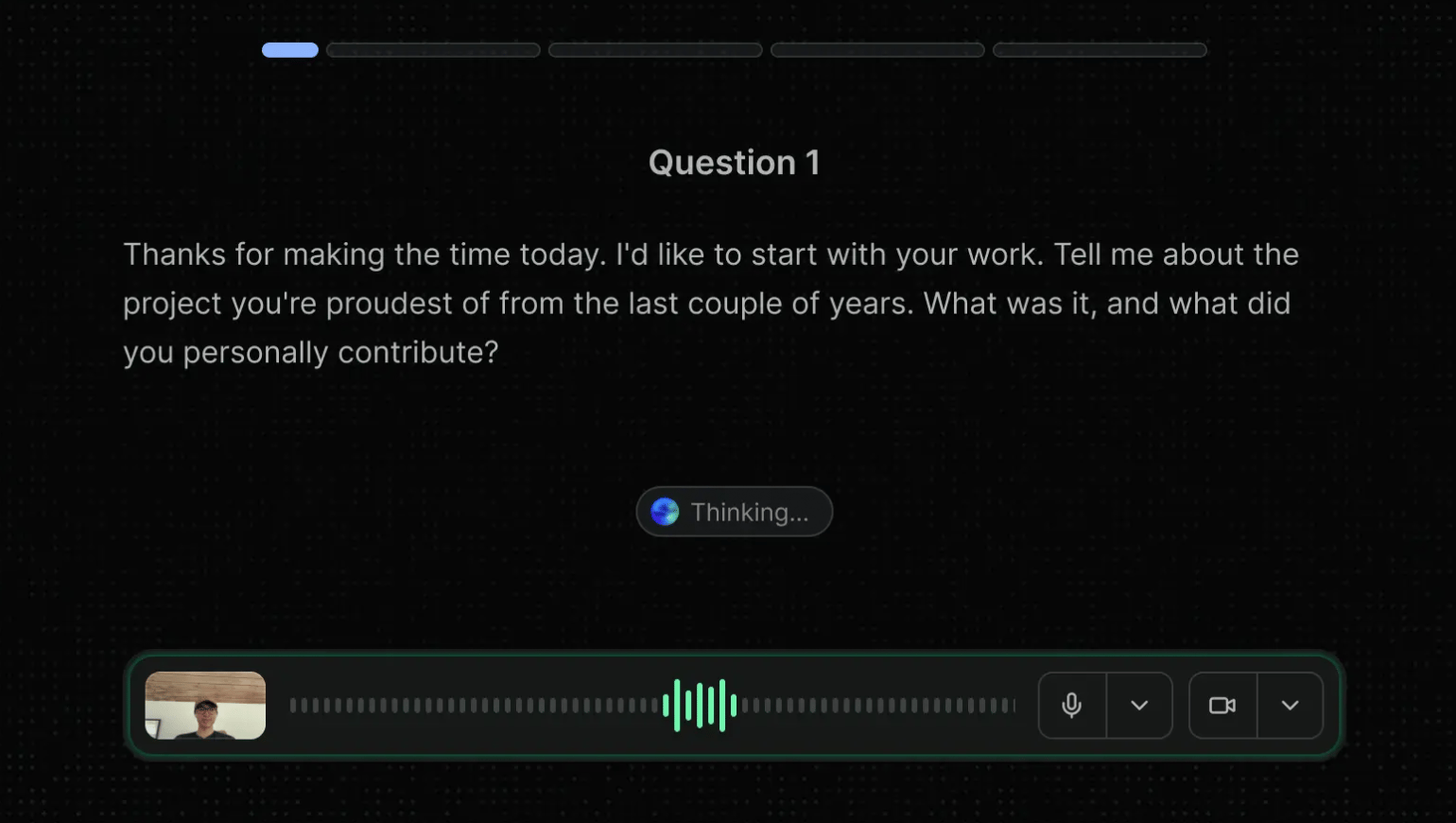
The AI interviewer only asks questions and listens. It doesn't decide anything.
How Screening Works
To create your first screen, open Metaview, click Screening in the sidebar, and clickNew screen.
1
Create a screen
Pick the role you want to screen for from your connected ATS, name the screen, and choose the pipeline stage candidates are imported from — plus the stages progressed and rejected candidates move to. If your ATS isn’t connected yet, the setup flow walks you through it. Candidates in the import stage appear in Metaview, but nobody is contacted until you enroll them.
2
Build the interview
Attach a job description and any context about what you’re looking for, and Metaview drafts an interview plan: a series of steps, each with a goal, one or more questions, and a rubric describing what a strong answer looks like. Edit anything directly, or use
Agent chat to describe the changes you want in plain language.3
Set up the candidate experience
Choose the languages candidates can interview in, whether their camera is
On, Optional, or Off, and what they see before they start — your logo, a welcome message, and an optional intro video from you.4
Preview and test
Preview as candidate takes you through the interview exactly as a candidate would experience it. You can also test a single question, or run the whole interview from the start, without leaving the builder. Previews are free and never consume credits.5
Publish and enroll candidates
Click
Publish to make the interview live, then enroll candidates from the Candidates tab. You can enroll them individually, in bulk, or turn on Auto-enroll to enroll every current and future candidate in your ATS import stage. Each enrolled candidate receives an invitation email with a personal link, plus reminders if you’ve set a deadline — see Publishing and Enrolling Candidates for the full flow.6
Review results
Each completed interview is assessed against your rubrics and rated
Great, Good, Okay, Poor, or Inconclusive, with a written summary and per-question notes. Open a candidate to watch the recording, read the synced transcript, and see exactly which answers the scoring is based on. When you’re ready, Progress or Reject candidates and Metaview moves them to the right stage in your ATS. You always make the final call — Metaview never auto-rejects anyone unless you’ve explicitly turned on rejection at the deadline, and that’s triggered by a missed deadline, never by a rating.Scorecards
Every completed interview gets a scorecard. It includes an overall rating and summary, and for each question: how well the answer matched your rubric, factual notes on what the candidate said, what remains unknown, and links to the exact moments in the transcript. Underneath the question results, an Also mentioned section captures useful things the candidate volunteered that your questions didn’t ask about — a notice period, who referred them, a competing offer, a relocation plan. It’s empty when nothing came up beyond the interview plan. Ratings are based on your own rubrics rather than a generic standard, and they’re intended to support your review, not replace it. Ratings are produced from the transcript of the conversation — there’s no video analysis, and no audio analysis beyond turning speech into text — so the strongest rubrics describe the substance of a good answer rather than its delivery. Recordings are there for your playback, not the AI’s. For more on writing rubrics and using Screening responsibly, see Screening Best Practices. If you edit and republish your interview plan, scorecards are regenerated so results stay comparable across candidates.Interview Integrity Signals
Screening automatically analyzes the interview transcript for signals that may indicate scripted or externally assisted answers, including potential use of AI tools, as well as potential inconsistencies with the profile the candidate applied with. Each signal is shown as low, medium, or high risk, with reasoning and links to the relevant moments in the transcript.What Candidates Experience
Candidates receive an email invitation with a personal link and take the interview from their browser, on desktop or mobile, whenever suits them before the deadline. There’s nothing to schedule. Before starting, they run a quick check on their microphone, speakers, and connection, choose an interview language if you’ve enabled more than one, and can blur their background if their camera is on. If they get disconnected, they can rejoin within a few minutes and pick up where they left off. It’s a genuine two-way conversation, not a form: candidates can interrupt, ask for a question to be repeated, or ask for clarification, and the interviewer follows up when an answer needs more. There’s no avatar on screen. The interview is designed to minimise distractions, and even natural-looking avatars introduce them — nodding, lip movements, and facial expressions that don’t quite land. For now the effort goes into voice quality and a natural conversation instead: warm, comfortable to talk to, and easy for candidates to speak openly about their experience. For the full candidate-side walkthrough, see the candidate guide — it’s written for candidates, so you can also link it in your own communications.Screening Credits
Screening credits are used to pay for interviews: one credit is consumed each time a completed candidate interview is evaluated. Building, publishing, and previewing screens is free. Workspaces come with free credits to get started, and you can buy more from Screening →Credits. See Screening Credits for the full details.
Hit a problem with a screen, or looking for a more specific answer? See Screening FAQs & Troubleshooting.